A freezer is the only place in a kitchen where food can be saved and lost at the same time. Two containers of soup from a productive Sunday, half a bag of peas, a wrapped piece of fish, and something dense and pale in a bag nobody can identify all sit under a layer of frost. The meal that would have solved a Tuesday goes uneaten, dinner gets ordered anyway, and six months later the mystery bag goes in the bin. Freezing food well is easy. Remembering it is the hard part.
Why the Freezer Turns Into a Black Box
The problem is visibility, not discipline. A fridge announces its contents every time the door opens, so leftovers get eaten because they are staring back. A freezer hides everything: items are opaque, frosted, stacked, and shoved to the back by whatever came later. Add the fact that frozen food carries no visible urgency and the result is predictable. Nothing looks like it is about to go off, so nothing gets used, and the pile grows until the door will not close.
A system beats a memory here because the memory is competing with a closed door. What follows takes about twenty minutes to set up and a few seconds a week to maintain.
The Five Parts of a System That Holds
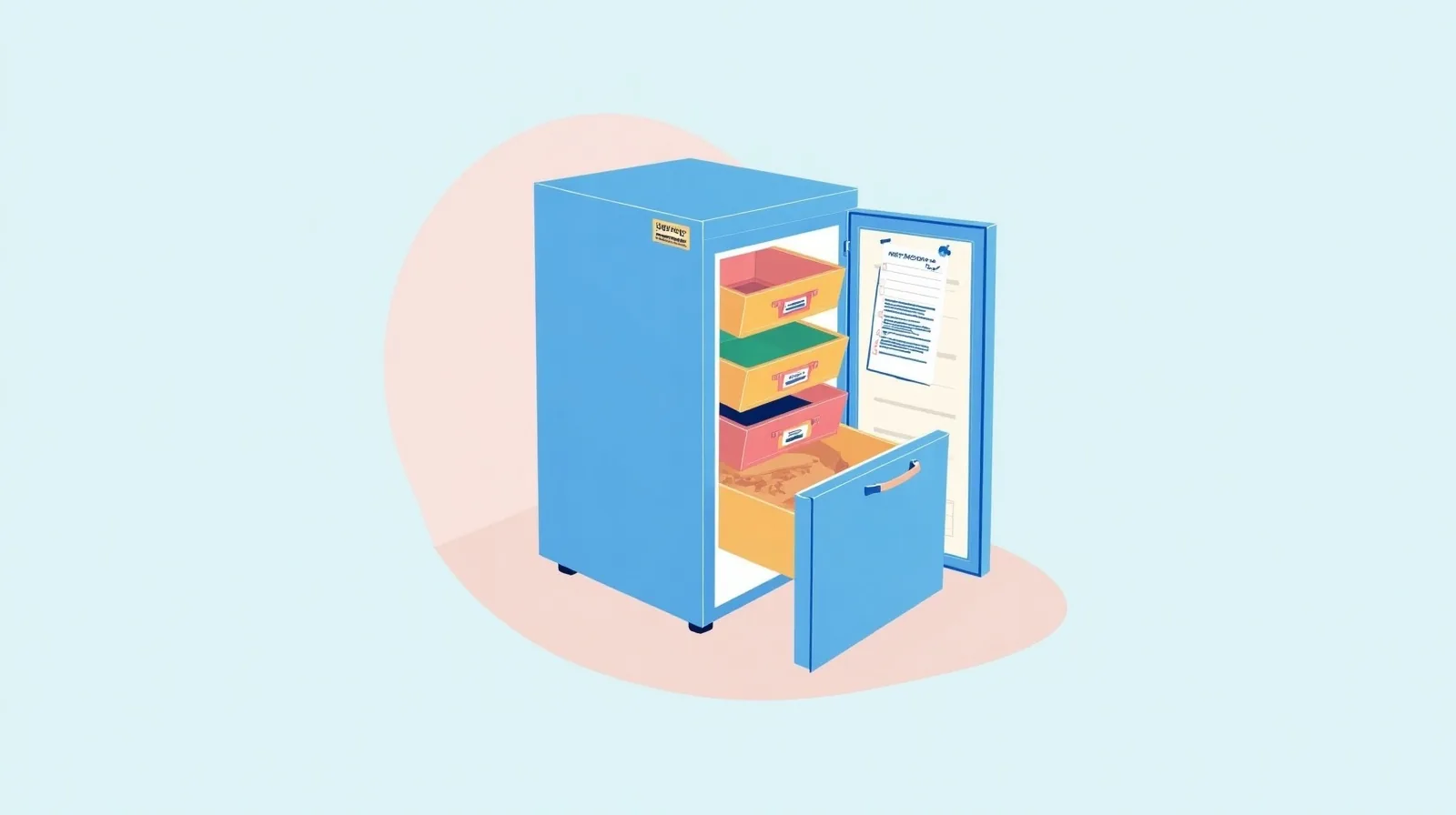
- A running list on the door. A sheet of paper and a pen taped to the freezer door, or a note on a phone. One line per item goes on when something goes in, and the line gets crossed off when it comes out. Everything else in this list only works because the door list exists.
- Labels that name the food and the date. Freezer tape or a paint pen on the bag, every time, with no exceptions for obvious items. Nothing is obvious four months later under frost.
- Bins that zone the space. Three or four cheap open bins turn a heap into categories: cooked meals, raw proteins, vegetables and fruit, bread and baked goods. A bin can be lifted out and looked through in ten seconds.
- A first-out shelf. One reserved shelf, drawer or bin holds whatever should be eaten next: the oldest items, the odd halves, anything approaching the edge of its window. Cooking from that shelf first becomes the default.
- A monthly use-it-up night. One dinner a month gets built entirely from the freezer. It sounds like a chore and works like a small windfall.
Labels That Tell the Truth
Most labels fail by being too vague or too optimistic. A useful label carries three things: what it actually is, the date it went in, and the portion or quantity. Something like chicken and white bean chili, four portions, with the date, does far more work than the single word chili. Add a reheating note when a dish needs one, because the person facing that container on a Wednesday will not want to think.
Quality windows are worth respecting even though frozen food stays safe at a steady temperature almost indefinitely. Cooked meals and most vegetables are at their best within a few months, ground meat and fatty fish sooner, bread sooner still. Writing the date is what makes any of that usable, since guessing always errs toward the bin.
The Use-It-Up Night
Put one night on the calendar each month and cook whatever the first-out shelf holds. Odd combinations are the point: a soup stretched with frozen vegetables, a tray of roasted odds and ends, rice fried with peas and a chopped piece of leftover meat. Clearing that shelf makes room, resets the rotation, and quietly returns real money to the grocery budget.
Once a season, take the whole thing further. Pull everything out onto the counter, wipe the shelves, bin whatever is genuinely past it, then reload by zone and rewrite the door list from scratch. Twenty minutes of that, twice a year, keeps a freezer functioning as storage instead of a very cold archive.