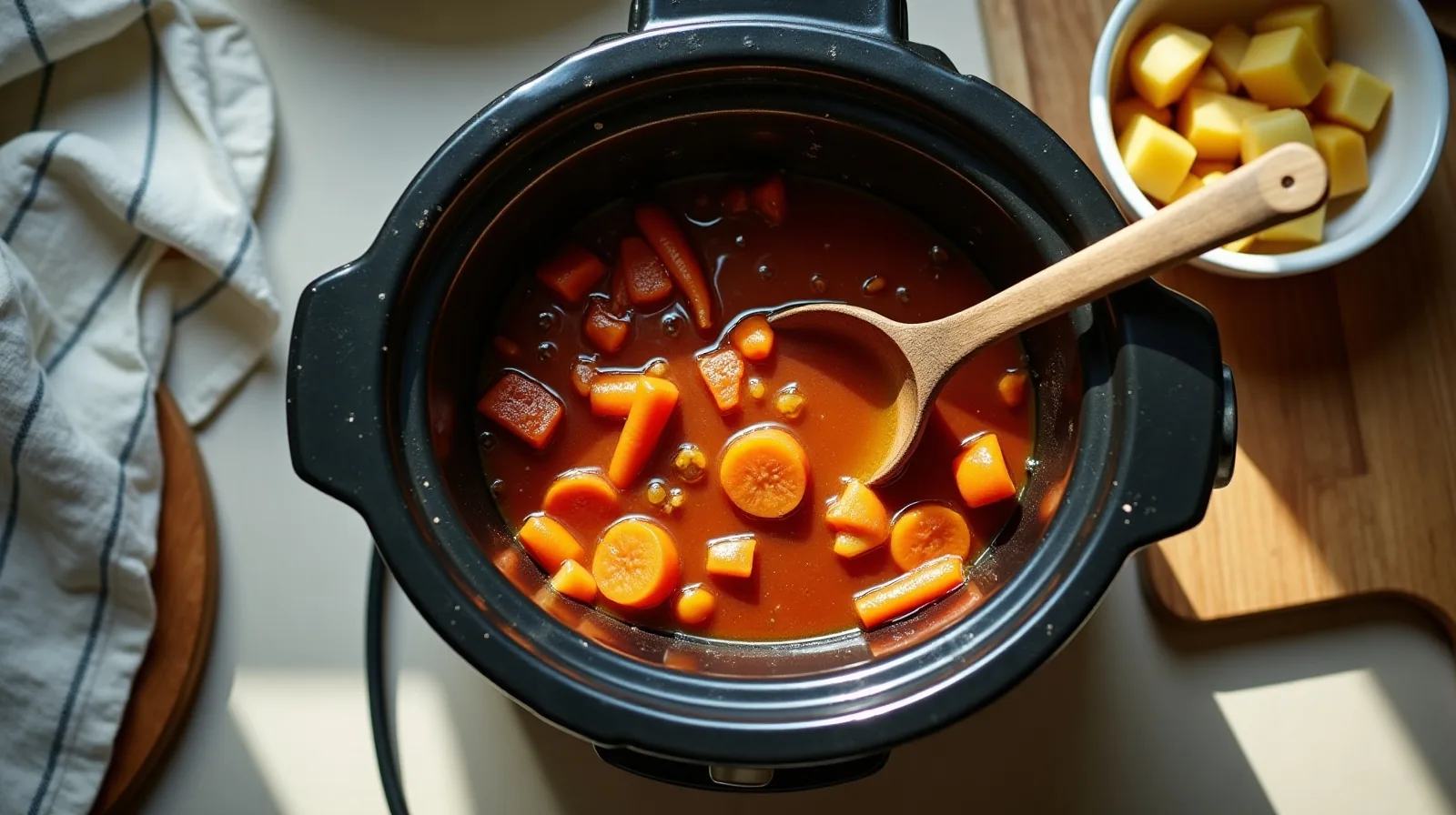
The promise of a slow cooker is dinner that looks after itself. The reality, often enough, is a lid lifted at six o’clock over a pot where everything has arrived at the same texture: shredded meat, carrots dissolved into orange threads, and a thin liquid tasting faintly of all of it at once. Nothing burned. Nothing is wrong, exactly. It is just mushy and a little flat, and the cause is almost always one of a handful of habits rather than the machine.
Why Everything Ends Up the Same Texture
A slow cooker is a sealed, low, wet environment. Barely any liquid escapes, because the lid traps steam and drips it straight back into the pot, and the temperature sits below a proper simmer for hours. Those conditions are ideal for tough cuts, which need long moist heat to turn connective tissue silky. They are punishing for anything delicate. A vegetable that would be tender in twenty minutes on the stove gets eight hours instead, and its structure has to go somewhere.
Understanding that one fact fixes most slow cooker dinners, because every common mistake below is a version of the same problem: treating the pot as a container that heats things rather than as a specific cooking environment with its own rules.
Five Habits Behind a Mushy Dinner
- Filling the pot to the brim. An overloaded cooker heats unevenly and takes so long to come up to temperature that the food at the bottom overcooks while the top lags. Somewhere between half and three-quarters full is the working range, and an underfilled pot scorches at the edges.
- Adding dairy at the start. Milk, cream, yogurt and soft cheeses curdle and separate over long heat, then leave a grainy sauce. Stir them in during the last twenty to thirty minutes instead, with the heat down.
- Treating every vegetable the same. Potatoes, carrots and other roots want to be cut into large chunks and buried at the bottom, where the heat is strongest. Zucchini, peas, greens, shellfish and fish belong in the final half hour.
- Pouring in as much liquid as a stovetop recipe calls for. Almost nothing evaporates under a sealed lid, so a stew that would reduce on the stove simply stays soupy. Cut the liquid by roughly a third unless the recipe was written for a slow cooker.
- Lifting the lid to check. Every peek releases the trapped steam that does the cooking and can add twenty to thirty minutes to the total. Look near the end, not in the middle.
Rescuing a Watery Sauce
A thin sauce is fixable in the last stretch, and there are three approaches worth knowing. The simplest is to take the lid off for the final thirty to forty-five minutes with the heat turned up, which finally lets steam escape. The second is a slurry: a spoonful of cornstarch whisked into cold water, stirred through, then given fifteen minutes to thicken. The third works best for stews already full of starchy vegetables. Lift out a ladle of potato or bean, mash it, and stir it back in.
Flavor usually needs the same late attention. Long cooking flattens acidity and dulls fresh notes, so a squeeze of lemon, a splash of vinegar, a handful of chopped herbs and a fresh grind of pepper at the end will lift a pot that tasted muddy five minutes earlier.
A Loading Order That Works
Build the pot in layers rather than dumping everything together. Brown the meat and soften the onions in a pan first if there is time, because a slow cooker cannot create that flavor on its own. Roots and other hardy vegetables go on the bottom in big pieces. Meat sits on top of them. Liquid comes up roughly two-thirds of the way rather than covering everything. Delicate vegetables, dairy, fresh herbs and acid all arrive at the end. Cooked that way, a slow cooker produces something with distinct pieces in it, which is the whole point.