
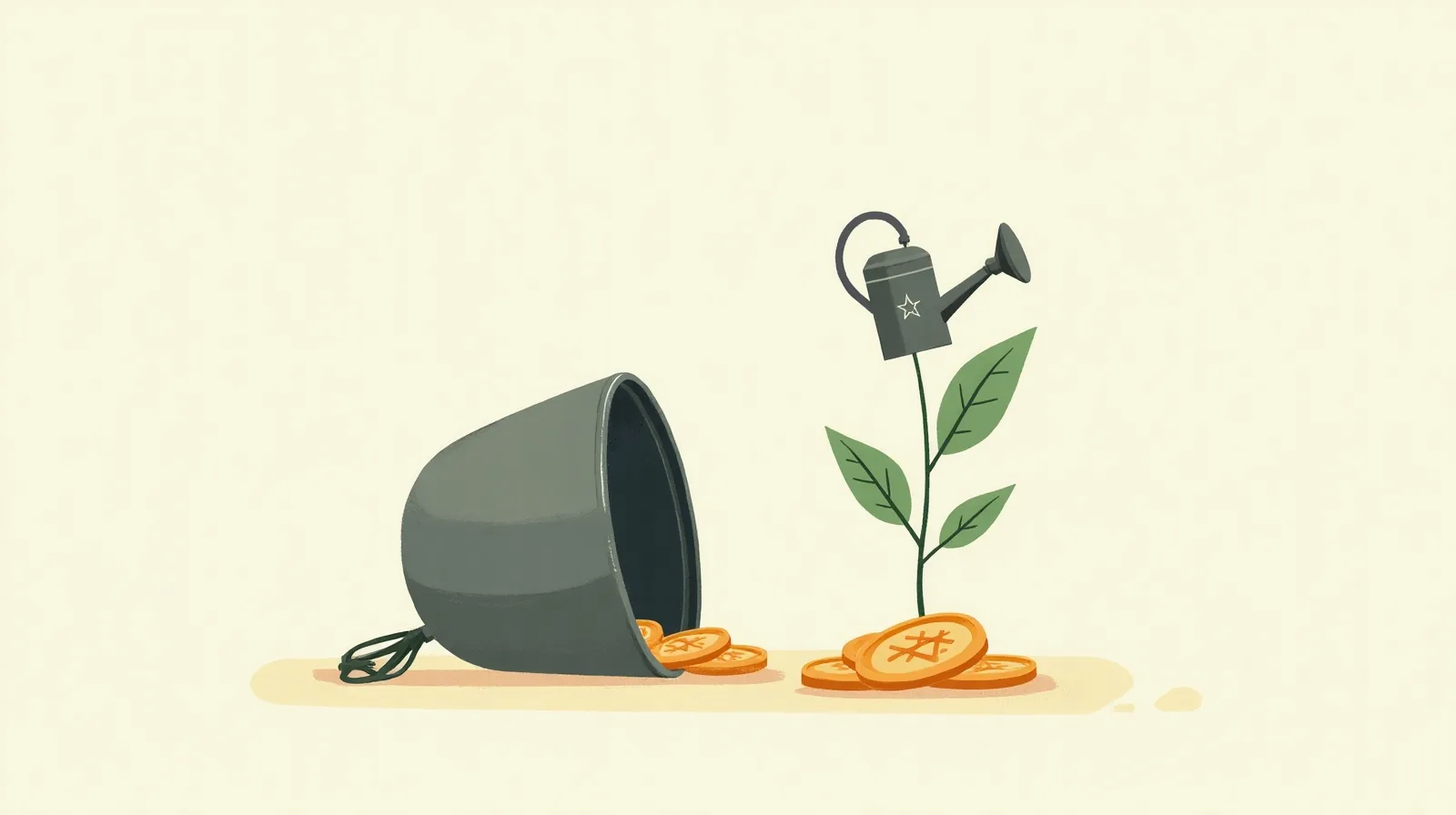
Money is one of those subjects parents keep meaning to get to — after the tooth-brushing battles, after the homework, someday. But kids don’t wait for the lesson. They’re watching every checkout line, every “not today,” every tap of a card that makes groceries appear, and they’re drawing their own conclusions. Researchers who study children and money have suggested that basic money habits start forming surprisingly early — well before the first allowance. The good news is that teaching kids about money doesn’t require a curriculum. It mostly requires letting them near it, in doses sized to their age.
Little Kids: Make Money Visible Again
To a preschooler, a tapped card is magic — things appear and nothing seems to leave. So the first job is making money physical. Let small kids hold coins and bills, count them into jars, hand cash to a cashier, and wait for the change. Two ideas are worth planting early: money is what you trade for things, and when it’s gone, it’s gone. A simple three-jar setup — one to spend, one to save, one to share — turns those abstractions into something a five-year-old can rattle. Counting the save jar together every week is more persuasive than any speech about patience.
Elementary Age: Small Income, Real Choices
Around school age, kids are ready for a steady trickle of their own money. Families debate endlessly about whether allowance should be tied to chores; the honest answer is that both approaches can work, as long as the rules are consistent and the amounts are small enough that mistakes stay cheap. What matters is that the child genuinely controls it. Saving three weeks for a toy teaches waiting in a way no adult explanation can. And when they blow it all on something that breaks in a day — let it happen. A regretted purchase at eight is the cheapest tuition they’ll ever pay.
The Conversations That Do the Heavy Lifting
Most money education happens in passing, not at the table. A few habits carry it:
- Narrate your choices. “We’re getting this one because it’s the same thing for less” turns an ordinary errand into a lesson without slowing it down.
- Say trade-offs out loud. “If we eat out tonight, we’ll cook this weekend” shows that spending is choosing, not just having.
- Talk about ads. Kids who understand that commercials are designed to make people want things become noticeably harder to sell to.
- Let small mistakes stand. Rescuing every bad purchase teaches that money mistakes cost nothing — the one lesson you don’t want to land.
- Keep the tone calm. Kids absorb the emotion around money as much as the math. Neutral, matter-of-fact talk teaches more than silence or stress ever will.
Tweens and Teens: Bigger Numbers, Real Stakes
Older kids are ready for stakes that sting a little. A set clothing budget for the school year — handed over with real authority to choose — teaches planning faster than any app. A first job brings a paycheck, and with it a natural conversation about splitting earnings between spending now and saving for later. Teens can also handle more honesty about the household at whatever level feels right: what things cost, why the answer is sometimes no, how the family decides. Every family’s situation is different, and this is about habits and conversations rather than financial advice — the specific numbers and rules are yours to set. The pattern underneath stays the same at every age: give kids money at a scale where failure is safe, and talk about it like a normal part of life. Because it is.