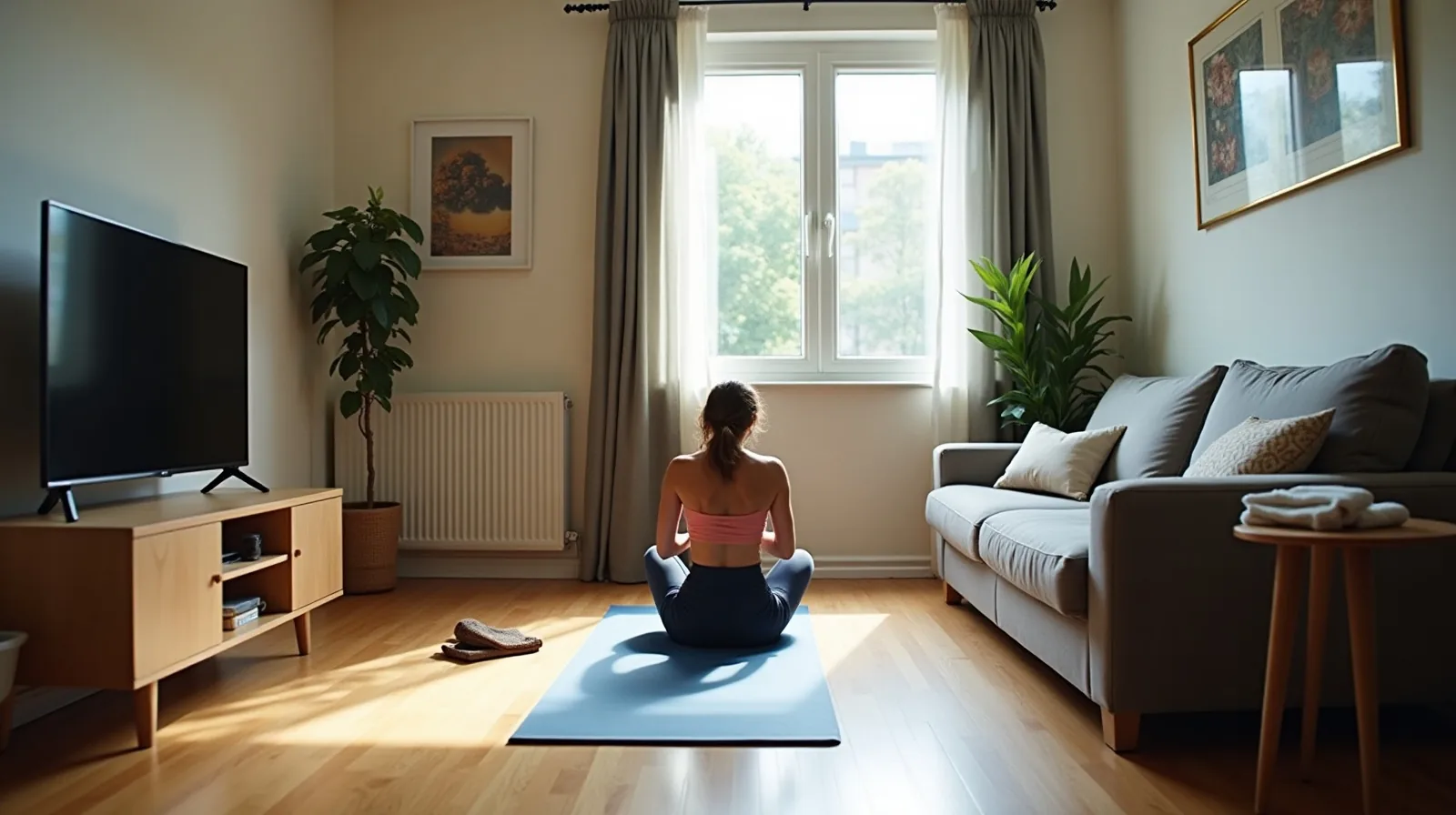
Apartment workout advice has a way of assuming a spare room nobody has. The real obstacles are more specific: a living room where the couch and coffee table leave a strip of floor the size of a beach towel, a downstairs neighbor who hears every landing, and walls thin enough to share your playlist. None of that actually rules out real exercise. It rules out jumping jacks at 6 a.m. — which is a much smaller loss than it sounds.
All You Need Is a Mat-Sized Rectangle
Run the honest test: can you lie down on your floor and swing your arms without hitting furniture? Then you have enough room, because nearly every effective bodyweight movement — squats, push-ups, lunges, planks, bridges — happens inside a rectangle about the size of a yoga mat. Sliding the coffee table over two feet is the entire gym setup. The constraint that actually matters in an apartment isn’t square footage; it’s impact and noise. So instead of waiting for a bigger place, build the workout around being quiet — which, conveniently, often makes it harder, not easier.
Quiet Moves for Thin Floors
Almost every noisy exercise has a silent sibling that keeps the effort and drops the thud:
- Step, don’t jump. Step jacks instead of jumping jacks; step your feet back one at a time instead of hopping into a plank. Same muscles, no impact.
- March, don’t run. Fast high-knee marching with a big arm swing pushes your heart rate up and makes no sound the neighbors will ever notice.
- Shadowbox. Three minutes of punches and footwork on a mat is honest cardio in four square feet.
- Slow everything down. A five-second lowering phase turns an ordinary squat or push-up brutal — tempo work builds strength in total silence.
- Hold still, work hard. Planks, wall sits, and glute-bridge holds are the quietest exercises ever invented, and among the most effective.
Your Furniture Is the Equipment
A small apartment comes pre-loaded with gear. A sturdy couch handles incline push-ups off the armrest, rear-foot-elevated split squats, and slow sit-to-stands that are harder than they look. The kitchen counter is a perfect push-up bar for beginners and a steady support for single-leg balance work. A hand towel under each foot on a hard floor becomes a slider for lunges and hamstring curls. And a backpack loaded with books turns squats, carries, and step-ups into weighted work — adjustable one paperback at a time. Two cautions: test that anything you lean on is stable and not on wheels, and keep towel-slider moves off rugs that skid.
A Simple Circuit to Start
Put it together and a real session looks like this: thirty seconds each of tempo squats, counter push-ups, high-knee marching, glute bridges, and a plank, with a short breather between moves — then repeat the loop three or four times. Twenty minutes, nearly silent, done in the strip between the couch and the coffee table. As with any change to your exercise routine, it’s smart to check with your doctor before starting — especially if you’re new to working out, managing a health condition, or dealing with joint pain. Low-impact doesn’t mean low-effort; it just means the only one who knows you worked out is you.