A lease usually rules out the satisfying stuff. No holes, no paint, no swapping the light fittings, no touching the floor. What is left can feel like a waiting room with your furniture in it — beige walls, a ceiling fixture that flattens every room it lights, blinds that came with the building. The good news for renters is that the changes with the biggest visual payoff happen to be the ones that leave no trace, cost less than a deposit, and travel to the next address in a box.
Change the Light First
Overhead lighting is the single biggest reason a rental reads as temporary. One bright fixture in the centre of the ceiling lights a room evenly and unkindly, and no amount of cushions will fix it. The renter’s answer is to stop using it as the main source. Three plug-in lamps at different heights — a floor lamp in a corner, a table lamp at eye level, a small one low on a shelf — turn a flat room into several pools of light, and none of them touches the wiring.
Bulbs matter almost as much as lamps. Matching the colour temperature across every lamp in a room, somewhere in the warm-white range for living spaces, is a ten-minute change that makes furniture, walls, and skin tone all look better. Battery puck lights inside a gloomy cupboard finish the job with adhesive backing and no tools.
Let Textiles Do the Structural Work
Fabric is the renter’s substitute for renovation. A large rug does what flooring cannot: it defines where the living area ends, absorbs the echo that makes empty rentals sound hollow, and hides a floor you would rather not look at. Bigger reads better than small, and a rug pad keeps it flat and protects whatever is underneath.
Curtains work the same way, and hanging them is where renters usually give up. Tension rods inside a window recess need no fixings at all, and full-length panels hung high and wide make a standard window look considerably larger. Add throws over tired upholstery, a fabric wall hanging where a picture would need a nail, and cushion covers that can be swapped without storing another cushion.
Cover What You Cannot Change
Some surfaces are simply not yours to replace, and the trick is to cover them convincingly and reversibly.
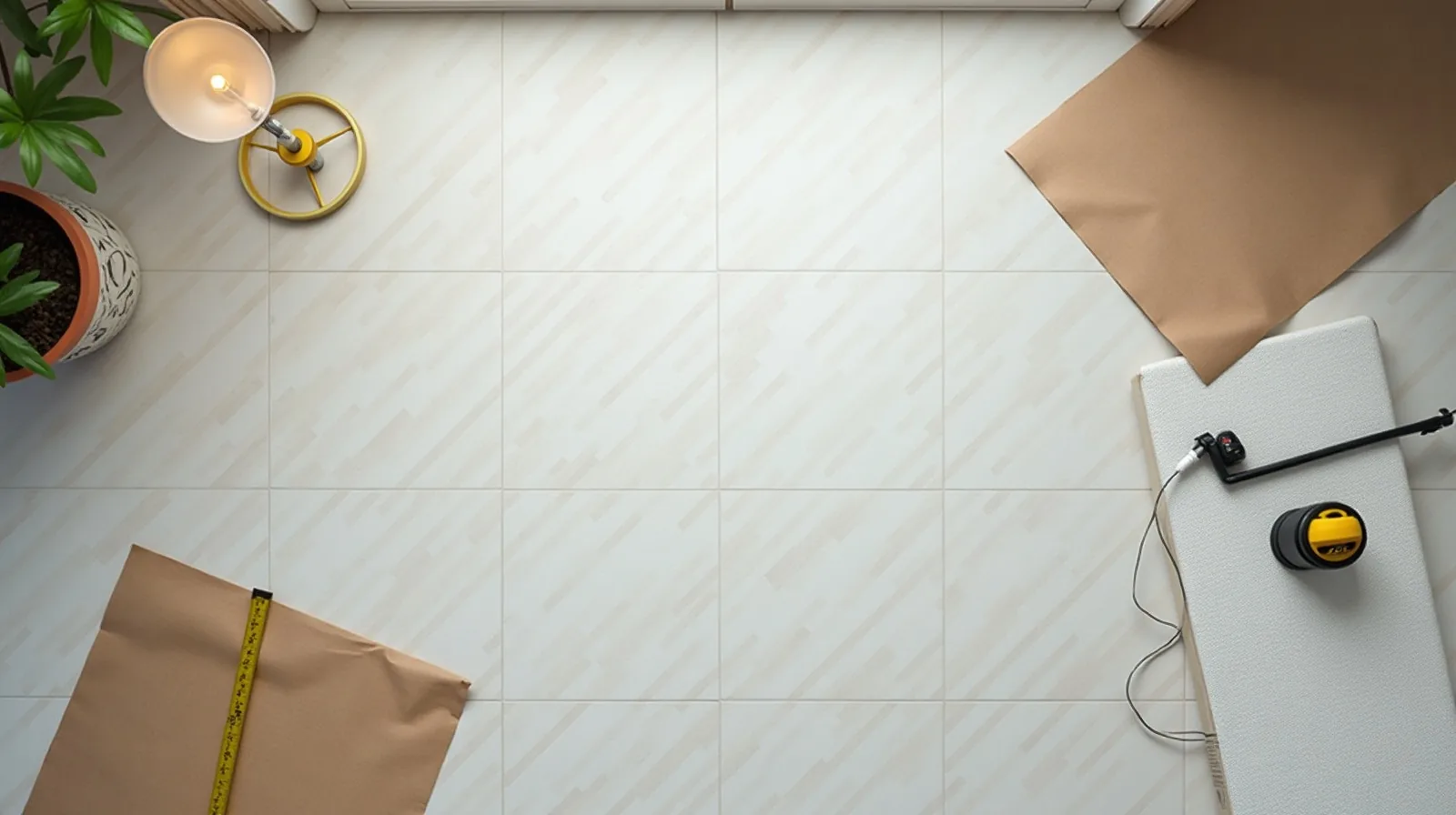
- Peel-and-stick tile or wallpaper. Good for a splashback or one feature wall. Test a small piece first, since it can lift paint on removal, and keep the leftovers for patching.
- Removable adhesive strips and hooks. They hold frames, hooks, and light shelving. Follow the weight limits honestly and pull them straight down and slowly.
- Interlocking or loose-lay floor panels. They sit on top of an existing floor with no adhesive and lift out on moving day.
- Magnetic or clip-on covers. A fabric cover over a radiator, a magnetic sheet over a metal cabinet door, a fitted cover over a dated worktop.
- Standalone screens and room dividers. A folding screen or an open shelving unit divides a studio without a single fixing.
Storage That Stands on Its Own
Rentals are usually short on storage because built-ins are expensive to install. Freestanding pieces solve it and count as furniture, so they move with you: a tall open shelf against a bare wall, a bench with a lid by the door, stacking baskets under a console, a rolling cart in a kitchen with no pantry. Tall and narrow beats low and wide in a small flat. Anything tall should still be anchored where a child or pet might climb it, and that particular hole is one most landlords will accept.
What Landlords Usually Allow
Most disputes are avoidable with one email. Landlords generally have no objection to lamps, rugs, curtains on tension rods, freestanding furniture, or bulbs, because nothing about the property changes. The grey areas are paint, wallpaper of any kind, drilled fixings, and anything touching plumbing or wiring. Ask in writing, keep the reply, photograph every room on move-in day, and store the original blinds and fittings in a labelled box so the place can be handed back as it was found.