
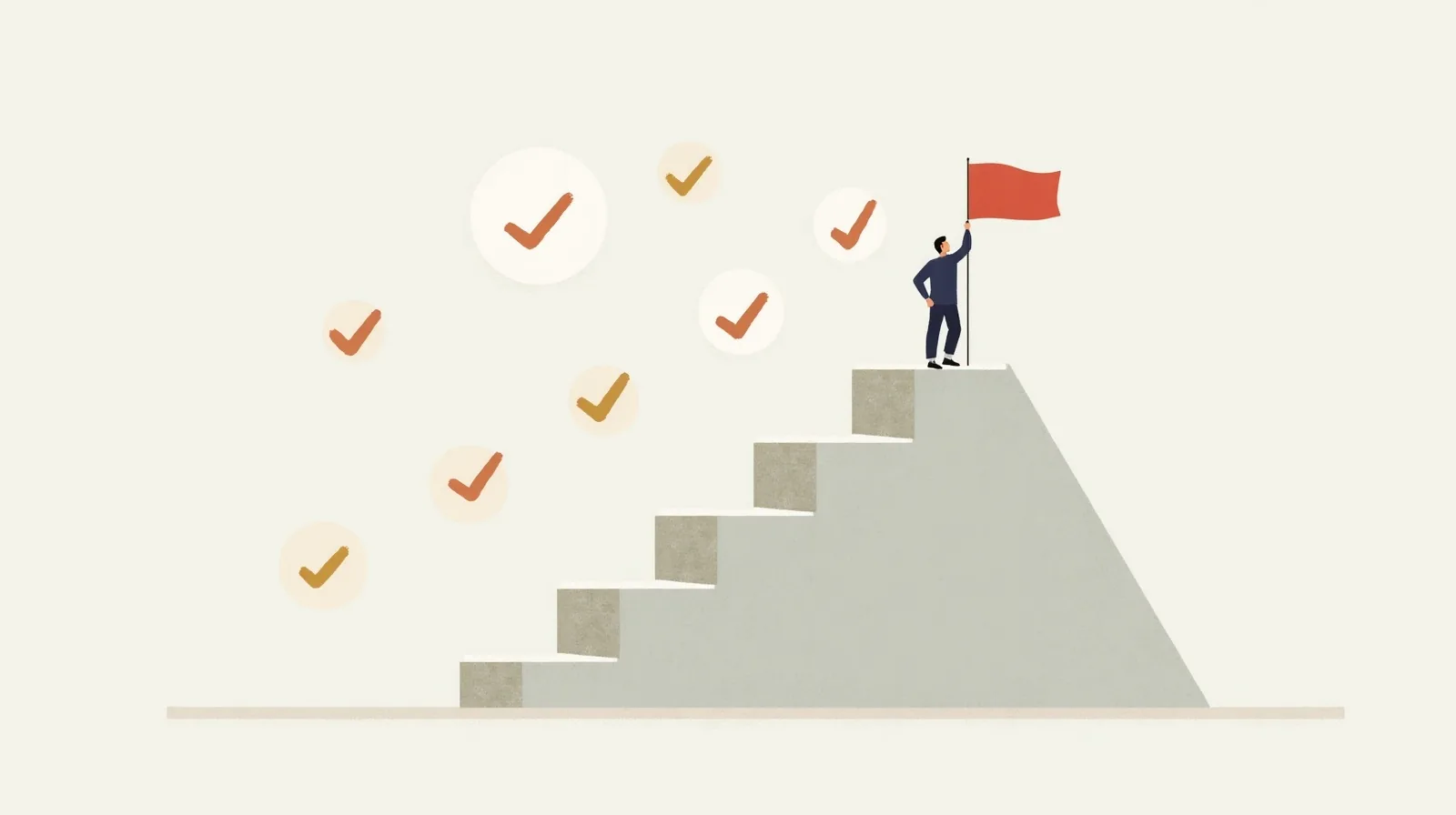
Most beginner fitness goals fail on paper before they ever fail at the gym. “Lose twenty pounds.” “Run a marathon.” “Get in shape by summer.” They’re written in a burst of motivation, for a future person who doesn’t exist yet, and they quietly guarantee the discouragement that ends most fitness attempts around week three. The fix isn’t lowering your ambition — it’s changing what the goal actually measures. And it works the same whether your thing is walking, lifting, swimming, cycling, or a dance class in the living room.
Why Outcome Goals Backfire
Outcome goals — a number on a scale, a race time, a clothing size — have two problems for beginners. First, the feedback is brutally slow: you can do everything right for three weeks and see almost nothing move, because visible results lag effort by a month or more. Motivation doesn’t survive that gap well. Second, outcomes are only partly yours to control — genetics, sleep, stress, and plain luck all get a vote. A goal you can fail while doing everything right is a goal designed to make you quit. And an outcome goal never tells you what to actually do on an ordinary Tuesday.
Set Process Goals Instead
A process goal measures the action, not the result — and the action is the only part you fully control. The reliable ones share a shape:
- Name an action, not an adjective. “Strength training twice a week” is a goal; “get toned” is a wish.
- Shrink it until it’s easy. A ten-minute session you’ll actually do beats an hour you’ll dread. You can always do more once you’re moving.
- Pin it to a time and place. “Tuesday and Saturday mornings, living room, before the coffee finishes” survives; “three times a week, whenever” doesn’t.
- Make it binary. Done or not done — no grading quality, effort, or how it felt.
- Set a floor, not a ceiling. The goal is the minimum that counts, not the maximum you might manage on a great day.
Track Consistency, Not Performance
For the first few months, the only number worth watching is how often you show up. A paper tracker on the fridge — one checkmark per session — makes that number visible, and a visible streak is surprisingly motivating. But build bend into it: a shortened session still counts, a walk on a scheduled run day still counts, and the working rule is never miss twice — one skipped day is life, two in a row is a drift starting. Hitting roughly four of every five planned sessions is genuinely excellent. Perfection isn’t the standard, and treating it as one is how January resolutions die in February.
Progress Slower Than You Want To
Once the habit holds, add load gently — a little more time, a little more weight, a slightly harder version, one small notch every week or two rather than doubling everything at once. Beginners’ hearts and muscles adapt faster than their tendons and joints, which is why early enthusiasm so often ends in a strain that costs a month. Plateaus are normal, not verdicts. And a word on safety: this is general information, not a personal prescription. Public health guidance broadly favors starting small and building gradually — and if you’re new to exercise, managing a health condition, taking medications, or feeling pain that goes beyond ordinary soreness, check with your doctor or a qualified professional before starting or ramping up a routine.