Most household mess is not a storage problem. It is a routing problem. A jacket comes off and lands on a chair, gets moved to the bed, moves again to the arm of the sofa, and finally reaches the closet three days later after four separate handlings. The jacket traveled a long way and nobody gained a thing. The one-touch rule is a single instruction aimed squarely at that pattern: when an object is picked up, it goes where it lives, the first time.
What the Rule Actually Asks
The rule is about direction, not speed. Every time something is touched, the only question is whether the next place it lands is its home or a waypoint. Waypoints are the expensive part. Each one buys a decision that has to be made again later, and decisions made in a hurry produce piles.
It follows that the rule only functions if everything has a home to go to. That is the quiet prerequisite most people skip. If the scissors have no drawer and the mail has no tray, one touch is impossible by definition, and the mess is a symptom of an unassigned object rather than a failure of discipline. Fixing the assignment is usually a five-minute job that pays out daily.
Landing Zones and Why They Fill Up
Every home has a few surfaces that catch everything: the kitchen island, the dining table, the chair in the corner of the bedroom, the bottom stair, the shelf just inside the front door. They fill because they sit exactly where hands are full and attention is already somewhere else. Watching where things genuinely get set down over a couple of days tells you more than deciding where they ought to go.
There are two honest fixes for a landing zone. Give it an official job with real containers, so the tray by the door becomes the mail’s actual home rather than a stop along the way. Or remove the surface entirely and put a hook, a basket, or a narrow shelf on the wall in its place. What never works is asking a wide flat surface beside a doorway to stay empty out of good intentions.
Building the Habit Room by Room
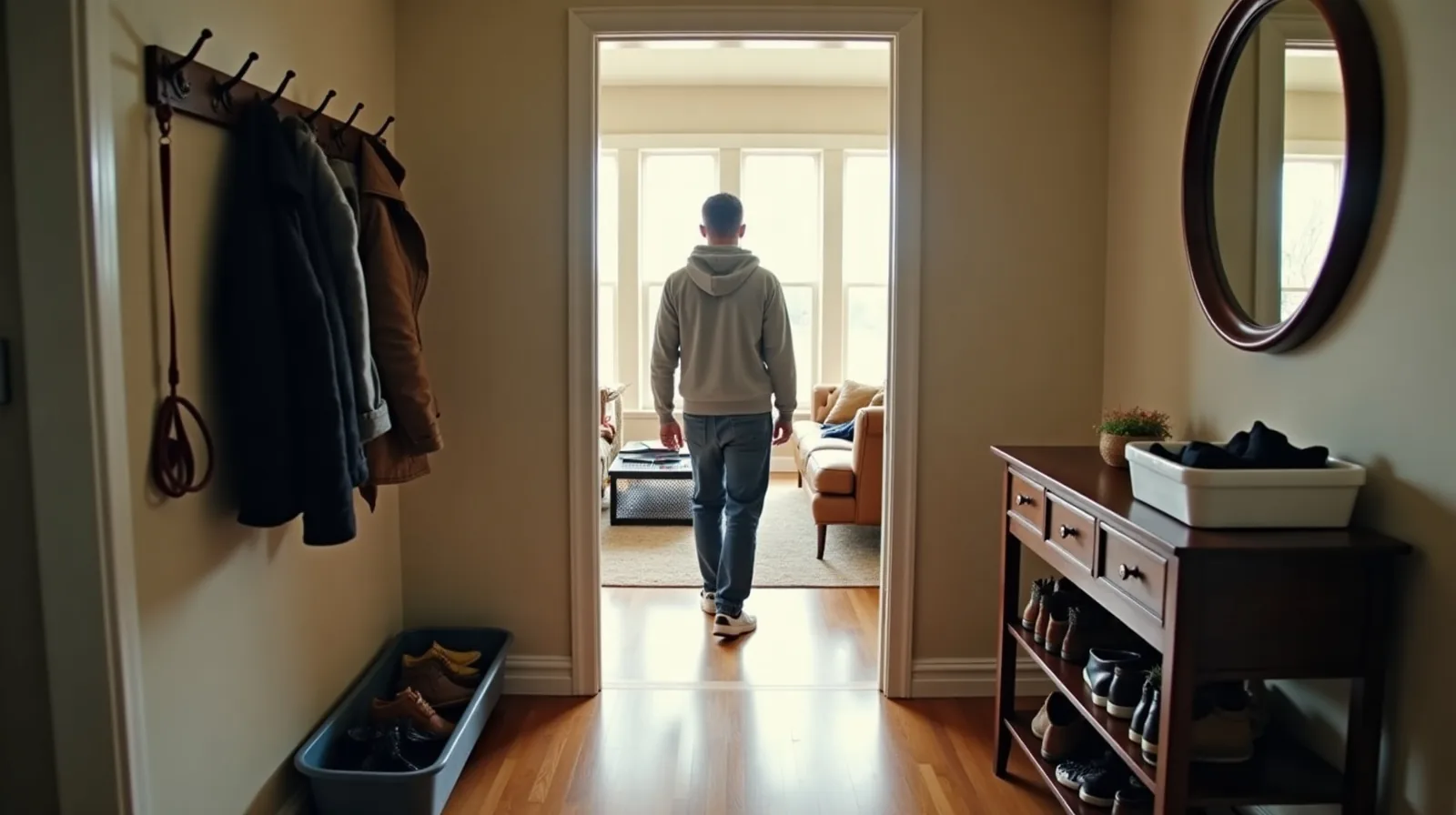
- The entry. Hooks hung at the height of the shortest person in the house, a shoe tray on the floor, a small dish for keys, and a lidded bin for the bag that ends up underfoot.
- The kitchen. Dishes go into the dishwasher instead of the sink, packaging goes straight into the recycling as it is opened, and the counter gets cleared while something is already cooking.
- The bedroom. Clothes worn once but not yet dirty need a real destination, and a single hook or valet stand for that category ends the chair pile better than any resolution has.
- The bathroom. Anything used daily belongs within arm’s reach of where it is used, because whatever requires a walk across the room gets left on the counter instead.
- Paper and mail. Open it standing over the recycling bin, act on anything that takes under two minutes, and file the rest into one tray emptied on a fixed day each week.
- Shared spaces. A labeled basket per person at the foot of the stairs collects stray items nobody claims, and each person empties their own on the way up to bed.
When One Touch Is Not Possible
Some tasks are genuinely better batched. Laundry, dishes, and unpacking groceries all run more efficiently as one focused session than as twenty small interruptions, and forcing the rule onto them creates friction with no payoff. The rule is aimed at individual objects in transit, not at chores meant to be done in bulk.
For everything else there is a reasonable fallback: two touches, and no more. Pick the object up, and if its home is genuinely on the other side of the house, put it into one designated staging basket that gets carried and emptied once a day. That preserves the point of the rule, which is that nothing should be moved twice for no reason, while still allowing for a real household with stairs, small children, and hands that are already full.