
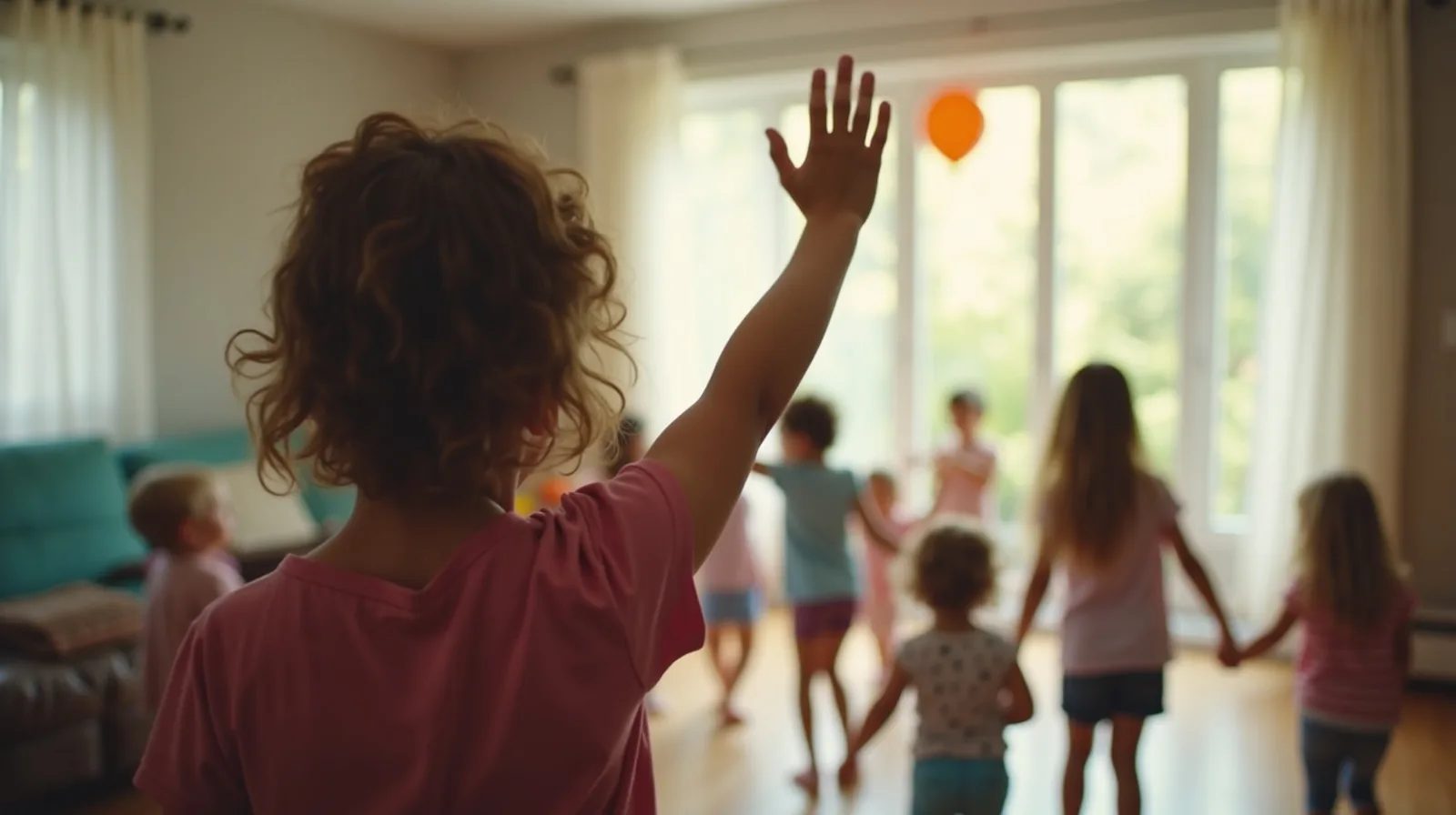
Somewhere between the invitation and the big day, birthday parties acquire a production schedule — and party-game ideas that involve forty cut-out paper fish, a homemade bean-bag toss, and a backup plan for the backup plan. Meanwhile the actual audience is a pack of excited kids who mostly want to run, shriek, and be told they did great. Here’s the liberating truth: the games that work best need almost nothing. No props, no printouts — just kids, some floor, music if you have it, and one grown-up willing to be the game-master.
Why Zero Setup Wins
A party runs on an energy arc, not a program: the trickle-in start, the wild middle, the sugar spike after cake, and the fragile final stretch before pickup. Games exist to steer that arc — and a game you can start in ten seconds actually steers it, while a game that needs assembly loses the room before it begins. Kids’ attention evaporates during setup; by the time the string is untangled, they’ve invented their own game, and it involves the couch. Zero-setup games have a second advantage: they cost nothing to abandon. When one stops working, you just call the next one — no sunk-cost table of sad, half-finished crafts.
The Games That Carry a Party
Keep this list in your pocket and you’re equipped for two hours:
- Freeze dance. Music on, kids dance; music off, everyone is a statue. Endlessly replayable — and for littler kids, skip eliminations so nobody sits out sad.
- Balloon keep-up. One balloon per two or three kids: don’t let it touch the floor. Count the taps out loud and it instantly becomes a team sport.
- Simon says. Old for a reason. Let the birthday kid take a round as Simon — being in charge is the real present.
- Hot potato. Any soft object plus music. Whoever is holding it when the music stops does a silly dance move instead of leaving the circle.
- Follow the leader. A parade around the room in animal walks — it works down to the youngest guest and doubles as a way to physically move the pack somewhere.
- Sleeping lions. The secret weapon: everyone lies perfectly still, and anyone who wiggles or giggles joins the spotters. A calming exercise disguised as a game.
Pacing the Pack
The game-master’s craft is sequencing. Alternate wild and calm — two rounds of freeze dance, then sleeping lions — so the group never redlines, and save the calm games for right before cake and the last twenty minutes, when tired kids tip into tears easily. Keep every round shorter than feels natural and quit while they’re still begging for more; a game that ends at its peak gets asked for again, and one that drags dies in front of you. Go easy on prizes, too — a prize table turns every game into a contest with one winner and five disputes, while big cheers and high-fives cost nothing and leave nobody crying.
Let Free Play Do Its Share
You don’t owe anyone a wall-to-wall schedule. Kids at a party default to free play happily, and some of the best stretches need no adult direction at all. Think of your game list as a tool you deploy at friction points — the awkward arrival window, a squabble brewing, energy curdling into chaos — not a program to complete. If the party ends and you only called three games, that isn’t a plan that failed. That’s a party that worked.