
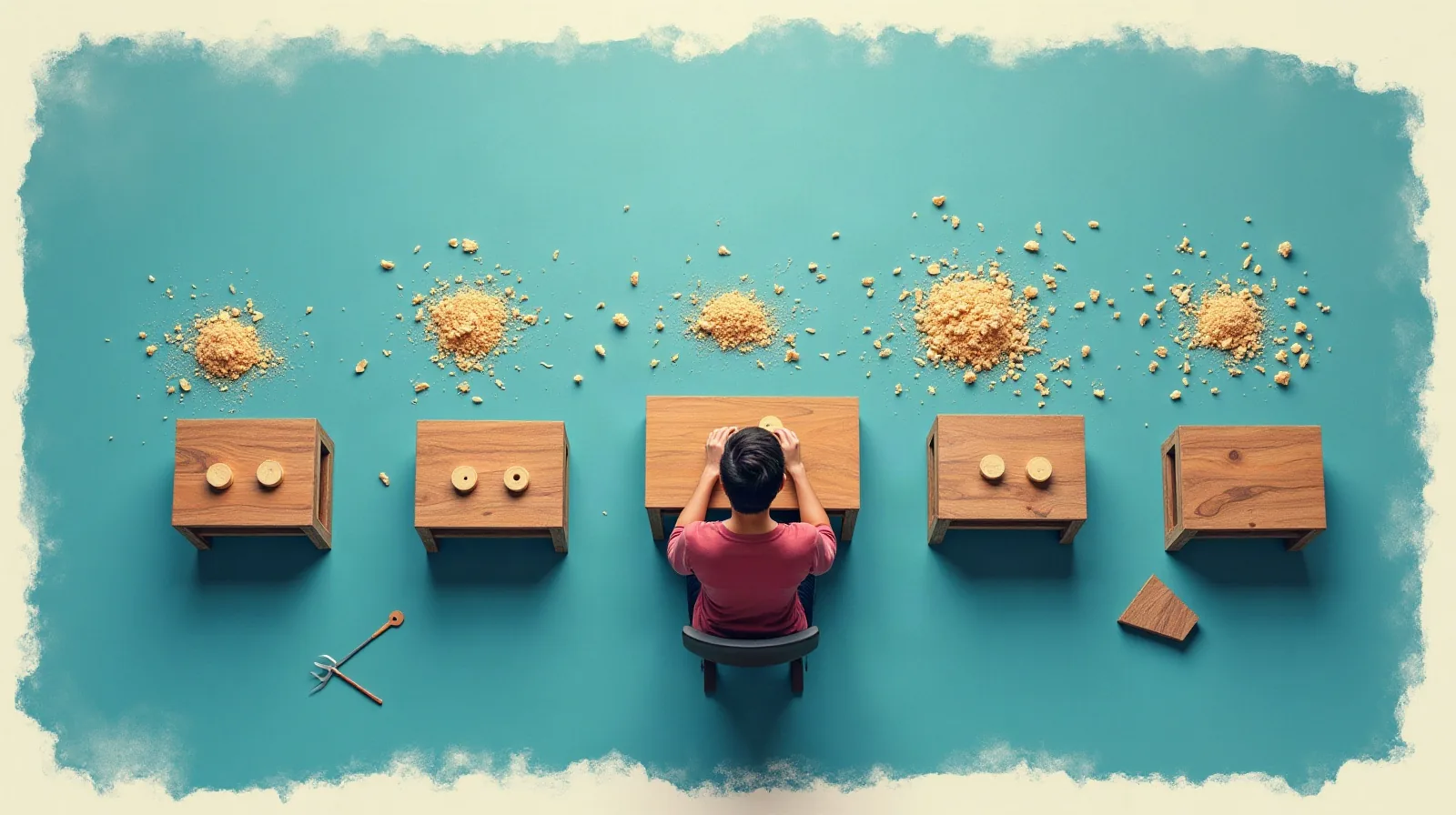
Somewhere in adulthood, being bad at something in front of other people stops feeling like practice and starts feeling like exposure. That shift is usually the real reason a new skill gets abandoned inside the first month, more than any shortage of time or the wrong course. School built the beginner phase into an ordinary stage everyone expected: a syllabus, a grade curve, a teacher who assumed nobody could do the thing yet. None of that survives into adult life, so a return to obvious beginner status reads as a step backward instead of the routine first stage of a fair trade.
Why the Beginner Phase Feels Worse Than It Is
Comparison does most of the damage. The people visibly practicing a skill in public are almost never beginners, so the baseline a first attempt gets measured against is quietly rigged from the start. It is easy to mistake that gap for evidence the skill was a bad idea, rather than evidence that it is simply new.
The bigger problem is structural. An adult has to supply the curriculum, the feedback, and the permission to be bad that school used to hand out automatically. Without it, the awkward stretch has nothing holding it up, and most attempts fold around week two or three, right when the fast early gains of total-beginner status level off.
Choose a Skill With a Reason Behind It
A goal like “learn to cook” or “get into painting” rarely survives a real week, because it has no shape to practice against. A narrower version tied to something specific — three chords for one particular song, ordering a meal confidently on a trip already booked — gives a session something to aim at.
A few questions sort a promising first skill from one that will quietly stall:
- Fits in about fifteen minutes, most days, without special equipment or a drive to reach it.
- Has a next step you could name right now, not just a general direction to head in.
- Connects to something already on the calendar — a trip, a gathering, a project — so it has a use waiting for it, not just a hope.
- Produces something small and real in the first week, not only study material.
Skills that pass all four tend to survive past the point where the initial motivation runs out, because the structure does some of the work motivation was supposed to do alone.
Build a Rhythm That Survives a Real Week
Short, frequent sessions beat long, occasional ones for almost any skill, because consistency is what turns scattered attempts into a compounding one. Fifteen minutes most days adds up to more real practice than one ambitious block that only happens when the week cooperates.
Attach the session to something that already happens, rather than relying on finding time for it fresh. Practicing right after a commute or a nightly routine borrows momentum a habit already has. A missed day is not a reset: the next session simply counts as the next one. One slightly longer weekly session, reserved for messier practice, covers what a quick daily rep cannot.
Getting Through the Ugly Middle
Early progress is often fast, simply because there is so much easy ground to cover. That speed sets an expectation the middle stretch cannot meet: gains slow, practice starts to feel identical day to day, and it is easy to mistake a flat week for a stalled skill. This stretch is where most people quit — usually while still improving, just too slowly to notice.
The fix is comparing further apart than one day at a time. A voice memo, a photo, or a saved first attempt from week one, set beside the same thing from week six, usually shows more movement than the daily feeling suggests. Judged against yesterday, a plateau can look permanent. Judged against a month ago, it rarely is.

Let the Evidence Decide What Happens Next
Once that saved evidence exists, a short monthly check-in is enough to decide what comes next, instead of guessing from how one week felt. Real movement means the current rhythm is working. No movement, paired with a reason for picking the skill that no longer applies, is permission to set it down or swap it — not proof the attempt failed.
Either outcome beats the alternative: quietly dropping a skill somewhere in the ugly middle and filing it away as something that was never really possible to learn.