
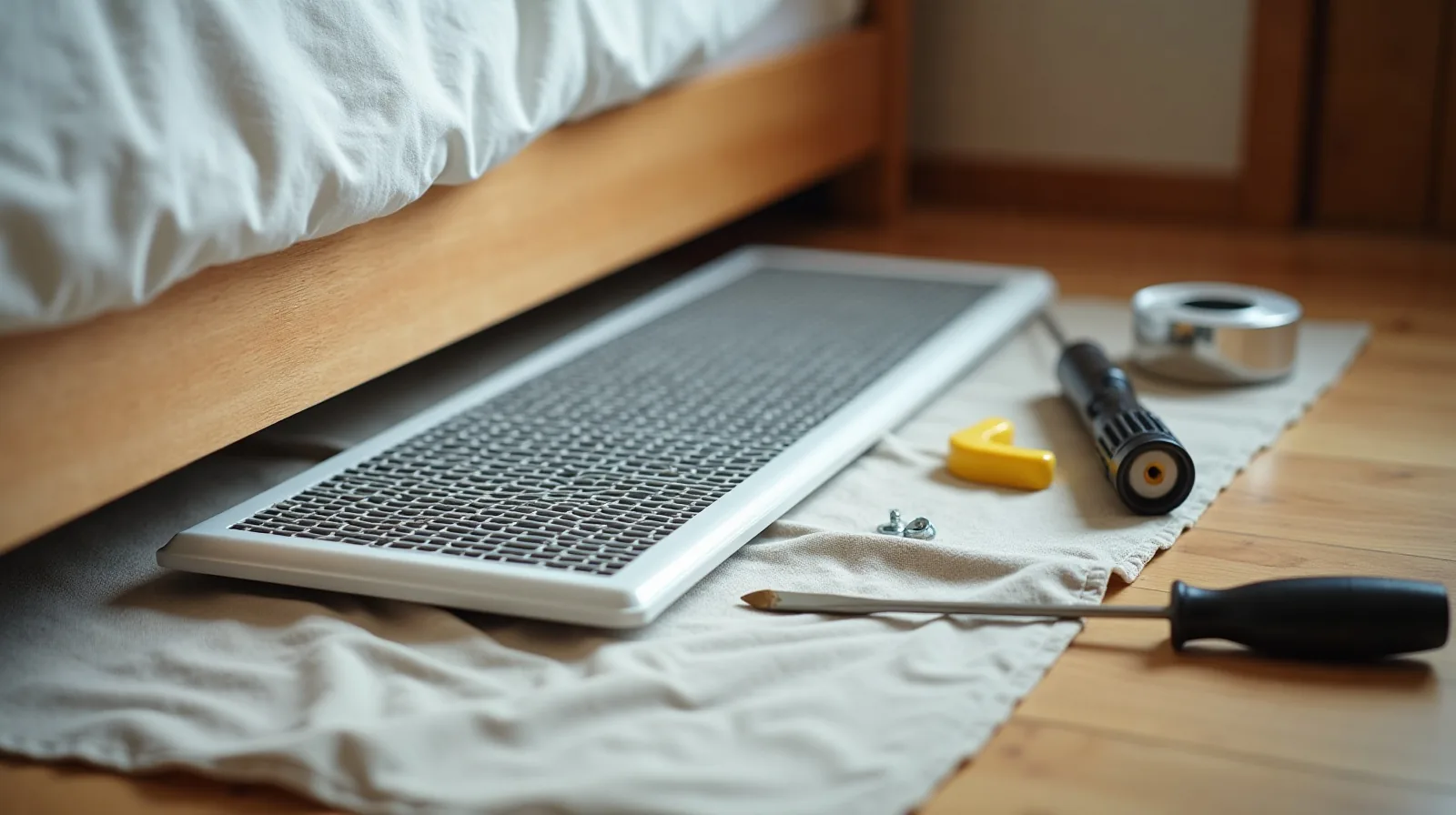
Almost every house has one. The back bedroom that needs a space heater in January while the living room sits comfortable. The office over the garage that never quite gets there. The instinct is to blame the furnace, but a system heating six rooms well and one room badly is rarely broken. It is unbalanced, or leaking, or being asked to heat a room its ductwork was never sized for. The useful part is that the cheapest checks are also the ones most likely to find the culprit.
Start With What You Can See in Sixty Seconds
Walk into the cold room and put a hand over every supply vent. If air is barely moving, look at the register itself: the little lever on the side may be half closed. Then look at what is sitting on top of it. A sofa pushed against the wall, a rug laid over a floor register, or a stack of boxes can cut a room’s airflow by more than half.
Check the filter while you are at it. A clogged filter starves the whole system, and the room at the far end of the run is always the first to notice. If the vent blows well but the room still lags, the problem is not the register.
Air Has to Get Out, Too
This is the failure homeowners almost never suspect. Every cubic foot of warm air pushed into a room has to leave it, or the room pressurizes and simply stops accepting more. Most houses have one or two central return grilles in a hallway and rely on air traveling back under the bedroom doors.
Close that door and the path narrows to a slot; with thick carpet or a door hung tight to the floor, there is no slot at all. Hold a tissue near the vent with the door open, then close the door and watch it sag. If the flow drops noticeably, you have a return problem, and the fixes are cheap.
- Undercut or vent the door. Trimming half an inch off the bottom, or adding a transfer grille above the door, gives the air a permanent way back.
- Clear the return grille. Hallway returns collect dust and get blocked by furniture and hampers. Vacuum the grille and give it a couple of feet of clearance.
- Balance the dampers. Look along the main trunk lines in the basement or crawlspace for handles on the branch ducts. Close the runs feeding warm rooms a quarter turn at a time, wait a day, then reassess.
- Label what you adjust. Mark each damper handle with tape, and expect to change it between heating and cooling seasons.
- Seal the leaks. Joints and seams in unconditioned attics, crawlspaces and garages leak heat into places nobody lives. Foil-backed tape or duct mastic fixes them; cloth duct tape dries out and falls off.
When the Room Itself Is the Problem
Sometimes the ducts are fine and the room is simply losing heat faster than it gains it. Rooms above a garage, over a crawlspace, or bumped onto a slab lose heat through surfaces the rest of the house does not have, and so do rooms with three exterior walls or oversized windows. On a cold night, run a hand along the ceiling, the baseboards and the window frames. Cold spots that follow a straight line usually mean missing or slumped insulation rather than a duct issue.
Insulating an attic floor and sealing the gaps around recessed lights frequently does more for a cold room than any adjustment to the heating system, because it changes how much heat the room needs in the first place.
What Is Worth Handing Off
Some things are not a homeowner job. If the room is far from the equipment and served by a long, undersized branch duct, no amount of damper tweaking will fix the physics, and a technician can measure static pressure and airflow to prove it. Before you pay for a bigger unit, get the balance, sealing and insulation right, because oversizing a system usually makes uneven rooms worse rather than better.