
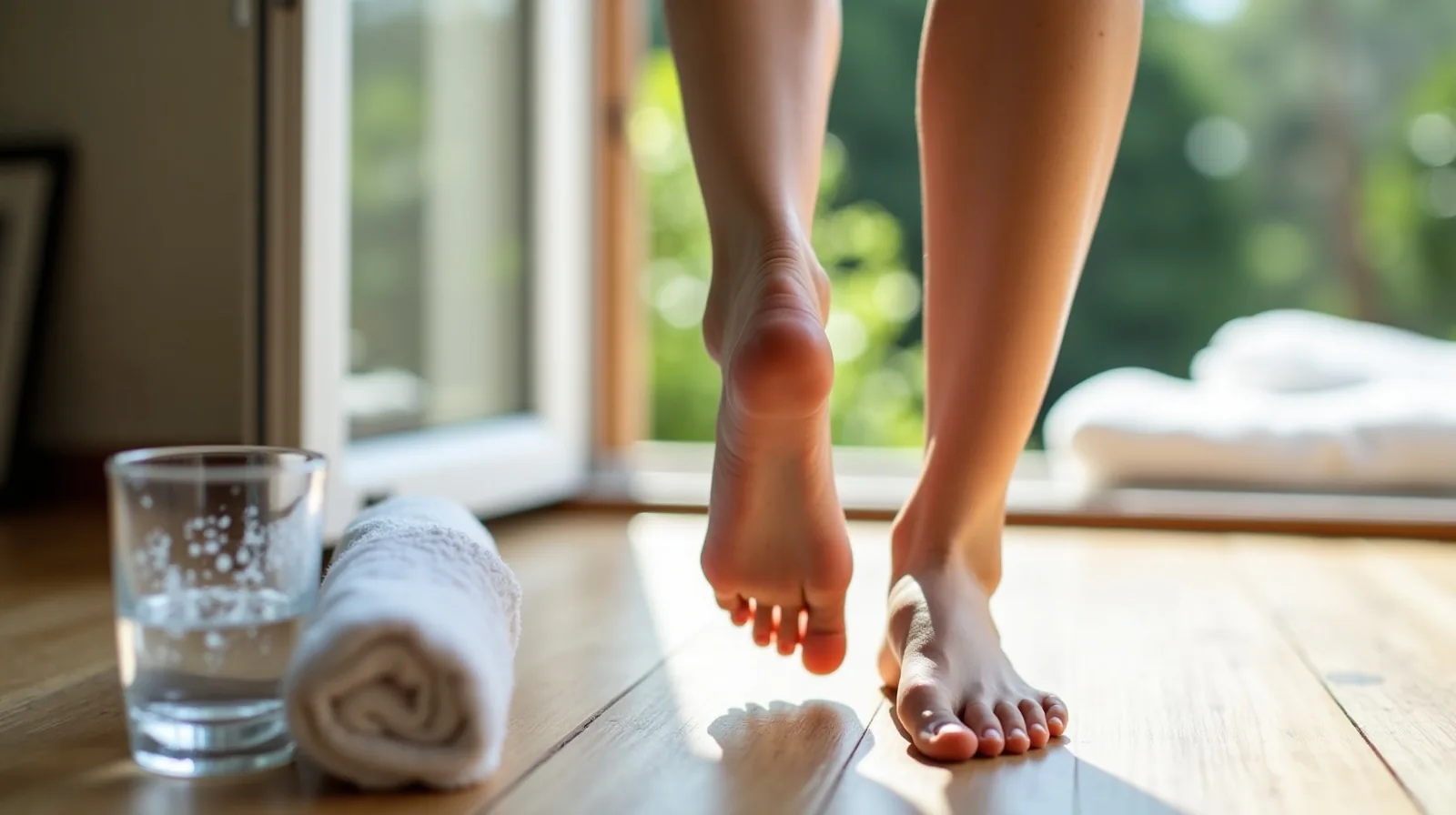
Mornings are when a body feels most like it was folded up and left in a drawer. Hips are tight from a night curled sideways, the upper back is stiff, and the ankles argue for the first few steps to the kitchen. A short standing routine, done in whatever you slept in, takes the edge off before the day starts asking anything of you. Five minutes covers it, and standing is the whole point: no mat, no floor, nothing to lower yourself onto and climb back up from.
Why Standing, and Why First Thing
Floor stretching has its place, mostly in the evening when there is time to settle into a position and stay there. Morning is a different job. What helps early is movement through a range rather than long holds: joints circling, muscles switching on, blood moving. Standing keeps the whole chain involved, because your feet, hips and spine have to cooperate just to keep you upright.
The other advantage is friction, or the lack of it. A routine you can do beside the bed, before coffee, without changing clothes or clearing floor space, is a routine that survives a bad week. Anything that needs setup is the first thing to get skipped.
Five Minutes, Joint by Joint
Work from the top down, roughly a minute per area, moving slowly enough that your breathing stays easy the whole time. Nothing here should be forced. The aim is to visit the edge of a comfortable range and come back, not to push through it.
- Shoulders and arms. Ten slow backward shoulder rolls, then ten big arm circles in each direction, letting the ribs move along instead of locking the torso still.
- Spine, forward and back. With knees soft, round the back and tuck the hips under, then reverse into a gentle open chest. Ten unhurried repetitions.
- Spine, side and rotation. Reach one arm overhead and lean away, five each side, then let both arms swing loosely across the body as the torso turns.
- Hips. Hold a wall or door frame, swing one leg forward and back ten times, then across the body and out ten times. Repeat on the other side.
- Ankles and calves. Rise onto the toes and lower slowly ten times, then draw five circles with each foot lifted just clear of the floor.
- One long reach. Finish standing tall, both arms overhead, lengthening through the whole body for two slow breaths.
Making It Actually Happen
Attach the routine to something you already do without deciding: the kettle heating, the shower warming up, the dog waiting by the door. Habits hold better when they borrow a cue from an existing one rather than asking for a fresh slot in a morning that is already spoken for.
Keep the bar low on rough days too. Two of the six pieces beats skipping entirely, and a partial routine repeated for months does far more than a perfect one abandoned inside a week. Consistency is doing most of the work here; the specific drills matter less than the fact that the joints get moved before the day starts.
What It Should Feel Like
Expect a mild pulling sensation that eases as you repeat a movement, and expect the first few repetitions to feel stiffer than the last. What you should not feel is sharp pain, a pinch inside a joint, tingling, or anything that lingers once you stop. Shrink the range, slow down, or leave that piece out on a day when a joint is unhappy about it.
General mobility work is exactly that, general. If you are recovering from an injury or surgery, live with a joint condition, or keep getting pain in the same spot, check with your doctor or a physical therapist before adding a daily routine. A couple of small corrections from someone who can actually watch you move is worth more than any list.