Every home has one: the drawer that opens two inches and then jams on a spatula handle, a knot of twist ties, and a pen that quit working years ago. The name is half the problem, because calling it the junk drawer gives it permission to accept absolutely anything. Fixing it for good takes about an hour, a cleared counter, and one decision most people skip entirely: what that specific drawer is actually supposed to hold. Dividers do help, but only after that decision has been made.
Empty It All the Way Out
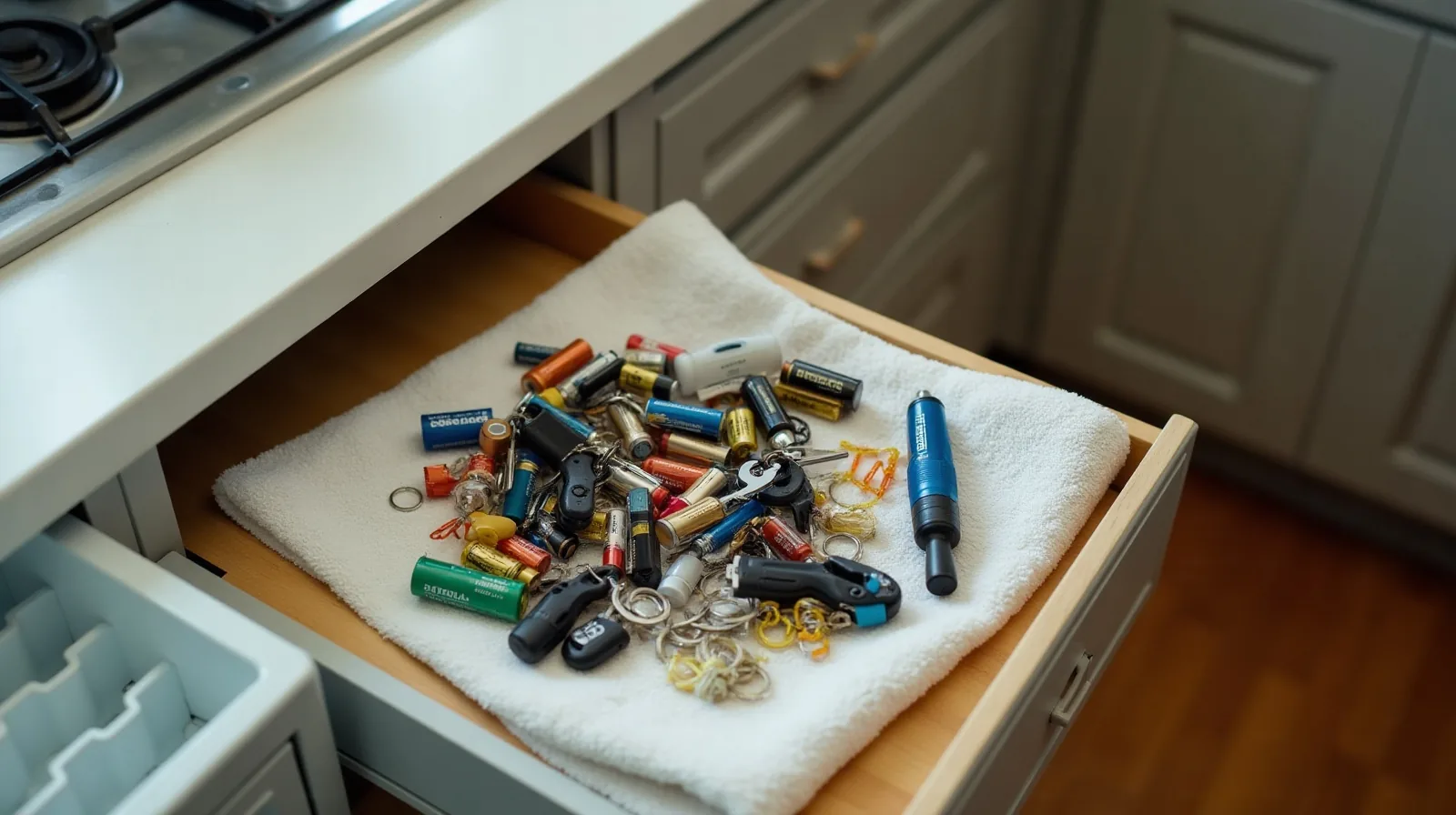
Pull the drawer off its runners if it will come, and tip the whole contents onto a towel spread across the counter. Half measures are why junk drawers come back: sorting around the contents leaves the sediment at the bottom untouched, and that is what fills the space again. With the drawer bare, vacuum the crumbs and grit out of the corners, wipe it down, and let it dry while the sorting happens.
Then sort the pile into groups. Not neat groups, fast ones. Every object gets handled once and lands in one of a small number of piles.
- Belongs in this drawer. Things reached for while standing in this exact spot, several times a month. Everything else is a guest.
- Belongs somewhere else. The screwdriver that lives in the toolbox, the charging cable that lives by the desk. Build one relocation pile and deliver it at the end.
- Dead or broken. Dried-out pens, spent batteries, cracked clips. Test the pens on scrap paper instead of guessing.
- Duplicates. Keep the best two of anything and pass the rest along. Nine pairs of scissors is a storage problem wearing a costume.
- Mystery hardware. Unlabeled keys, screws from something, a remote for an unknown device. Give them one small container and a six-month deadline.
Give the Drawer a Job
A drawer without a defined purpose defaults to holding whatever happens to be in someone’s hand at the time. So name the job out loud before anything goes back in: this is the quick-fix drawer, or the paper-and-pens drawer, or the small-tools drawer. A strong job for a kitchen drawer is the five-second grab — scissors, tape, a pen and pad, a small screwdriver, fresh batteries, a tape measure, a flashlight. Everything else has to pass a simple test. Would anyone really walk to this spot to reach for it? If not, it belongs to another room.
Naming the job settles arguments later too, because it turns “where does this go?” into a question with an actual answer.
Divide the Space Before Refilling It
Loose objects in an open box migrate; compartments stop the migration. Purpose-made inserts work well, but small boxes already in the house work nearly as well — a cutlery tray, gift boxes trimmed down to depth, a few jar lids for the tiniest items. Measure the inside width and depth first, since a tray a quarter inch too wide will sit proud and catch every single time the drawer closes.
Put the most-used compartments at the front, where a hand lands naturally, and push the rare or seasonal items to the back. Then leave one compartment deliberately empty. That empty slot is the pressure valve: it absorbs the new arrivals that would otherwise get shoved on top of everything already in place.
The Habit That Stops the Slide Back
Drawers refill through small, reasonable moments — unpacking a bag, clearing the counter before company arrives, emptying a pocket. Two habits hold the line. First, anything new that wants to move in has to claim a compartment, which means something else leaves. Second, give the drawer sixty seconds whenever it starts to resist closing: strays go back in their slots, and anything that drifted in from another room gets carried out.
Twice a year, run the fast version: empty, wipe, re-sort. It takes fifteen minutes rather than an hour, because the structure is already there. A drawer with a job, walls, and one empty slot stays useful far longer than a drawer that merely got tidied.