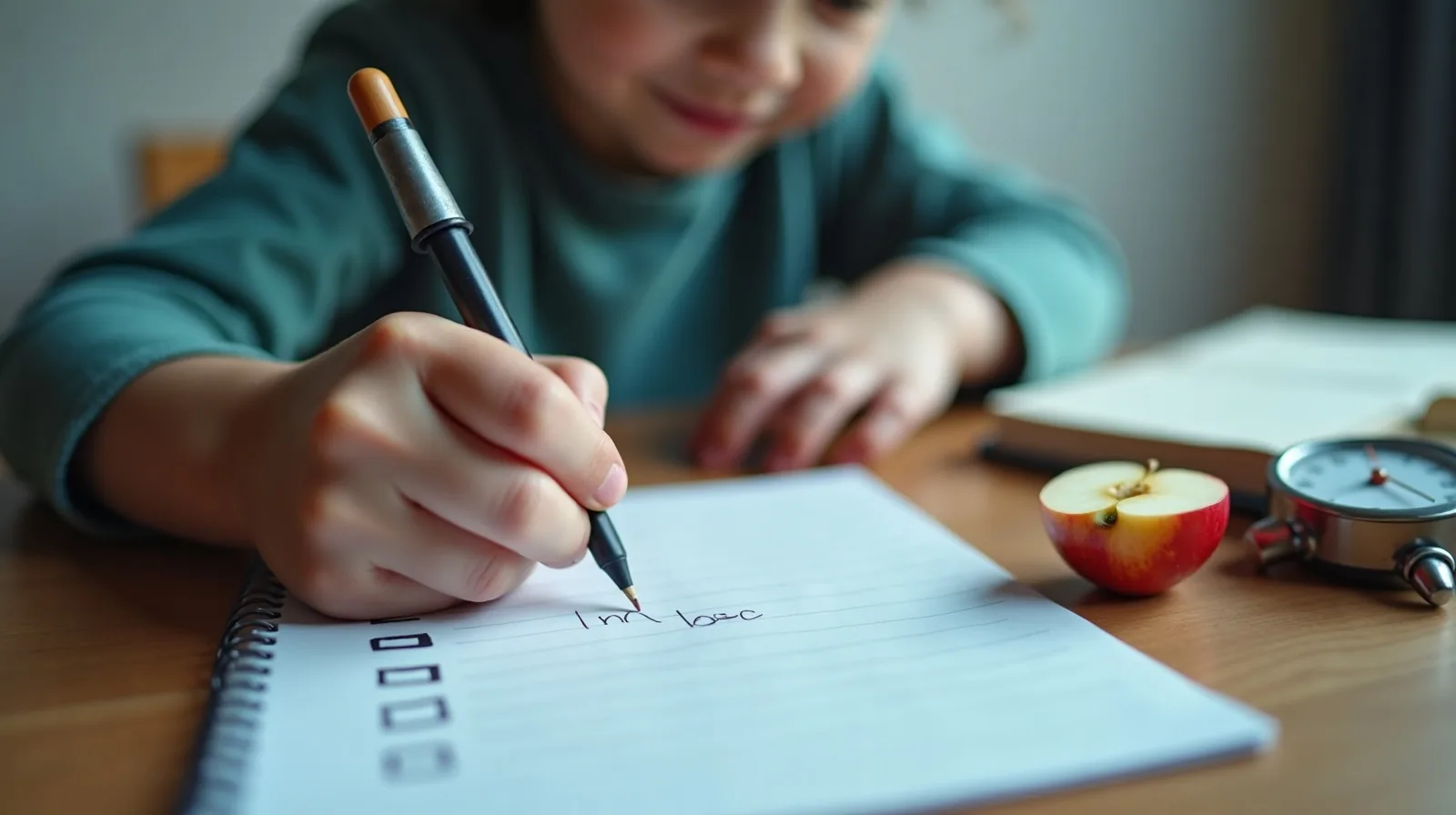
It is 4:45 in the afternoon. The folder is still in the backpack, the backpack is still by the door, and the negotiation has already started. Homework fights are rarely about the homework itself. They are about a tired child being asked to make a hard start with no defined edges, at an hour when their capacity for that is at its lowest point of the day. Most of the fix is structural, and it costs nothing: a predictable time, a predictable place, a visible finish line, and a parent who stays close without leaning over.
The Decompression Gap Comes First
School asks children to hold themselves together for six or seven straight hours. What is left when they walk through the door is not laziness; it is a genuinely depleted ability to focus, follow directions, and tolerate frustration. A gap of 30 to 60 minutes between arrival and homework prevents most of the conflict that would otherwise follow. Make it real rest: something to eat, some movement, preferably outside, and no questions about the day. Give the gap a defined end, though. “Homework at 4:30” is a routine, while “homework when you feel ready” is a nightly negotiation with a predictable outcome.
Same Time, Same Place, Every Day
Consistency does the work that willpower cannot. When homework happens at the same hour in the same spot, the setting itself becomes the cue, and the argument about whether to begin gradually stops occurring. Choose the slot that fits your particular kid rather than the one that sounds virtuous: some children do their best work immediately after the gap, while others genuinely function better after dinner. Keep the surface consistent and clear, put supplies in a single box that comes to the table and leaves with it, and keep screens out of the room. Give any new setup two or three weeks before deciding whether it works, because the first few nights of any routine are the worst nights.
Make the Work Visible and Finite
“Do your homework” describes an unbounded task, and unbounded tasks are where avoidance breeds. The goal is to convert a vague obligation into a short list of small, obviously finishable pieces.
- Write the list where both of you can see it. Three or four lines on paper, not a mental inventory held by the parent. What is invisible feels infinite.
- Chunk by task, not by clock. “Ten math problems” ends when it ends. “Twenty minutes of math” feels like a sentence being served.
- Take the easiest item first. Crossing something off early builds momentum, and momentum is worth more than optimal ordering.
- Put a timer where they can see it. A visible countdown for one chunk, followed by a real break, turns focus into a game with edges instead of an open-ended demand.
- Cross items off physically. A pen through a line is a small, tangible reward that a mental checkmark does not deliver.
- Set a hard stop. Decide in advance when the night ends regardless of what remains, and write a short note to the teacher instead of pushing an exhausted child past useful learning.
Nearby, Not Hovering
The most useful parent position is within earshot and busy with something else — folding laundry at the table, answering email, chopping vegetables at the counter. Close enough that questions are easy, far enough that every hesitation is not immediately supervised. When a question comes, ask what they have already tried before offering anything, and resist the urge to correct every mistake you spot. Work that arrives at school with errors intact tells the teacher something true about where the child is, which is precisely the information they need. Praise what is visible and controllable: sticking with a hard problem, starting without a fight, coming back after a break. And if homework routinely runs far past the time your school suggests for that grade, that is worth raising with the teacher directly, because the problem is likely the workload rather than the child.