A cast iron skillet works differently than nearly anything else in the kitchen. It does not arrive nonstick, and nothing at the factory keeps it that way — the slick, dark surface a well-loved pan eventually gets is built at home, one thin layer at a time. Understanding that fact changes how a skillet gets cleaned, stored, and fixed when something goes wrong, and it is the difference between a pan that improves for decades and one that turns dull, sticky, or rusty within a year.
What Seasoning Actually Is
Seasoning is not a product or a coating applied once and forgotten. It is a thin film of oil heated past its smoke point until it polymerizes — chemically hardens — into a hard, slick layer bonded to the iron. One layer alone barely changes anything. What creates the deep black patina prized on an old skillet is dozens or hundreds of layers, each added by ordinary cooking, especially anything cooked in a little fat. That is why a pan used often for eggs, bacon, or a seared chicken thigh keeps improving, while one left in a cabinet stays thin-seasoned and prone to sticking. Everyday care simply means not undoing that buildup faster than cooking replaces it.
Cleaning It Without Stripping the Finish
Modern dish soap does not ruin seasoning the way older advice claims — today's formulas are far milder than the harsh soaps that warning was built around. What actually damages a seasoned pan is prolonged soaking, an aggressive metal scouring pad, or a trip through the dishwasher, all of which strip the polymerized layer toward bare metal. A few simple habits avoid all of that.
- Clean it while it is still warm — food releases far more easily than once the pan has fully cooled.
- Use hot water and a stiff brush or nonabrasive sponge — a little mild soap is fine for a genuinely greasy pan.
- Skip the soak — a quick wash beats letting it sit in a sink of water.
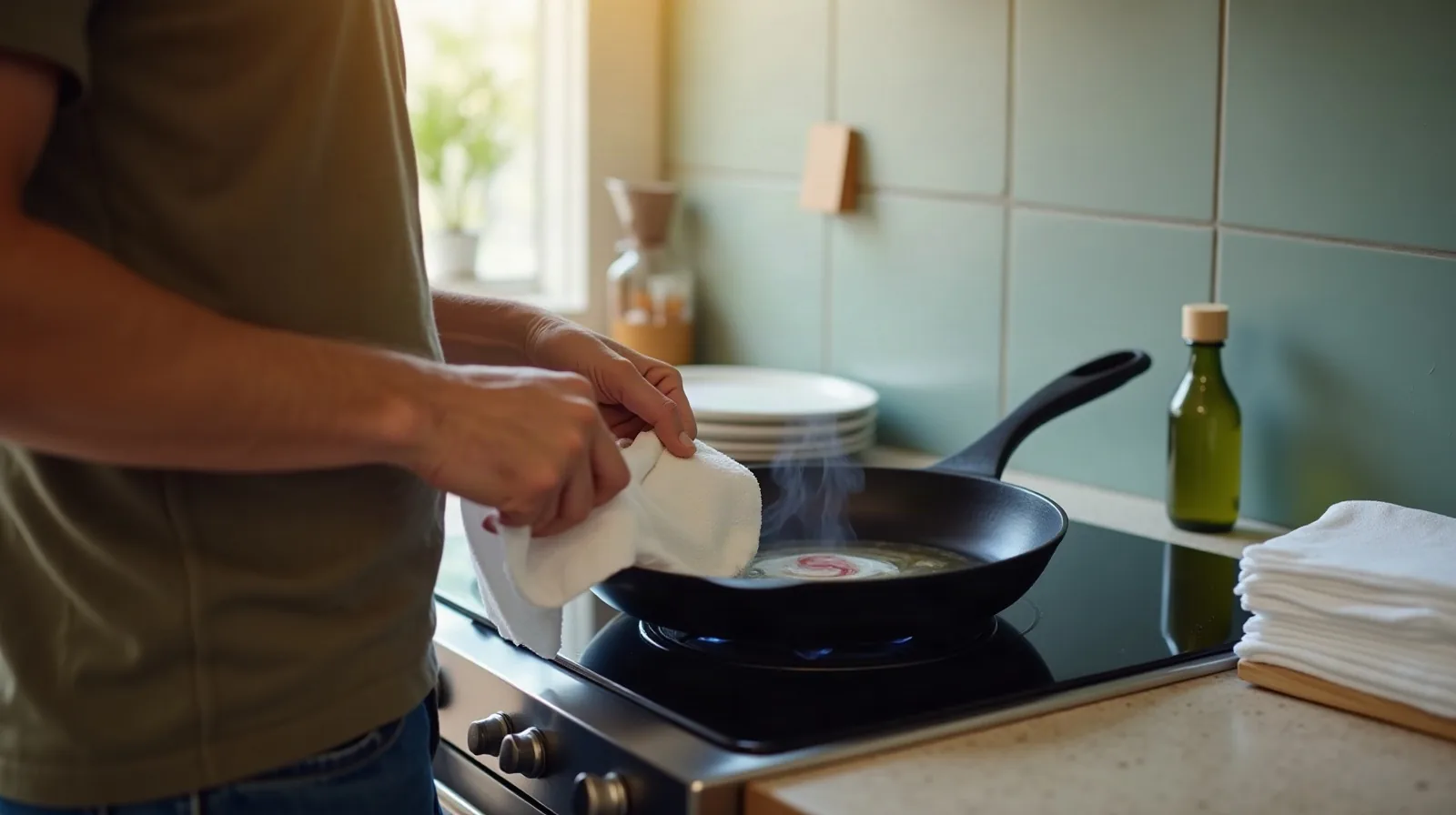
- Dry it completely, then add heat — a minute or two on a warm burner drives off any water hiding in the pores of the metal.
- Wipe on a whisper of oil while it is still warm — just enough to leave a faint sheen, not a puddle.
Fixing Rust and a Dull, Sticky Pan
Neither problem means the pan is ruined. A tacky or gummy surface almost always means too much oil was left on before the last heating — the fix is a light scrub, a full dry, and a much thinner wipe of oil next time. Rust is more dramatic to look at but just as fixable: scrub the spots with steel wool or a stiff brush under running water until the metal underneath looks clean, dry it thoroughly, then re-season from scratch with several thin coats of oil baked on one at a time in a hot oven. A cast iron pan can be taken back to bare metal and rebuilt as many times as it needs; unlike a nonstick coating, there is no finite layer to wear through for good.
The Everyday Habits That Keep It Nonstick
A newly seasoned or freshly stripped pan sticks more than a well-used one, so give it a run of forgiving meals — a sizzling protein, a stir-fry, cornbread — before trusting it with delicate eggs. Cooking something acidic like a tomato sauce is fine for the length of an ordinary meal, but letting it sit for hours can dull the seasoning, so plan to move leftovers to another container instead. In humid kitchens, a light interior wipe of oil before long storage heads off surface rust, and a folded paper towel stacked between pans keeps trapped moisture off the metal. None of it takes more than a minute, and it is the difference between a pan that keeps improving and one that needs rescuing every few months.